
Scott County Tentative Release Dates
MDOC uses the exact public label Tentative Release Date on an offender detail. Tentative means calculated but subject to change. It is not a promise that the person will walk out on that date. The same detail may show Entry Date, Location, Unit, Location Change Date, Number of Sentences, Total Length, county of conviction, sentence date, and offense information. Read each label as shown. A blank tentative date can occur, including on some life-sentence records, and does not mean release is near.
An actual release date records an event that has occurred. A discharge record may also state the release type and whether the person entered parole, earned-release supervision, or completed the sentence. A county jail release ledger serves that role for a Scott County jail booking. The jail record can distinguish a community release from transfer to MDOC, another jail, federal custody, or immigration custody.
Pretrial detention has a different timeline. A person awaiting trial has no sentence end date to calculate. A bond order, dismissal, or other court action may authorize release, yet another warrant, detainer, unresolved booking, or processing step may keep the person in custody. A court order proves legal authority. The jail’s timestamp proves the physical exit.
Find a Scott County Release Date
Start by identifying the custodian. Scott County Jail records local booking and release events. MDOC records state-prison custody, sentence computation, parole, ERS, and discharge. The court file supplies the sentence, bond order, amended judgment, revocation, or dismissal. Mississippi SAVIN/VINE reports custody events received from participating agencies, but its alert does not replace the source record. A federal or immigration case must be checked in the proper federal system.
Use this sequence for a projected or actual Scott County inmate release date:
- Ask where the person is held and confirm identity with at least two points. Use an MDOC number when one is known.
- For a state prisoner, open the MDOC Inmate Search, select the correct person, and transcribe the exact Tentative Release Date, status, location, sentence, and county labels.
- For a county detainee or local sentence, call Scott County detention at 601-469-1511 and request the lawful release computation or booking-release record. Obtain the court’s sentencing or bond order as well.
- Check for concurrent or consecutive terms, presentence credit, detainers, amendments, forfeited time, parole action, or ERS. Any one may affect the displayed date.
- Near the event, confirm with the current custodian. Afterward, request the actual release timestamp, disposition, and receiving agency if the event was a transfer.
The statewide path cannot prove an ordinary Scott County bond-out. The sheriff’s public “Inmate Roster” link redirects to MDOC, but that navigation choice does not turn the state search into a county booking archive. The broader Scott County released inmates lookup explains how county, state, court, VINE, federal, and immigration records fit together.
The official MDOC offender detail example shows the labels used for status and release-date fields.
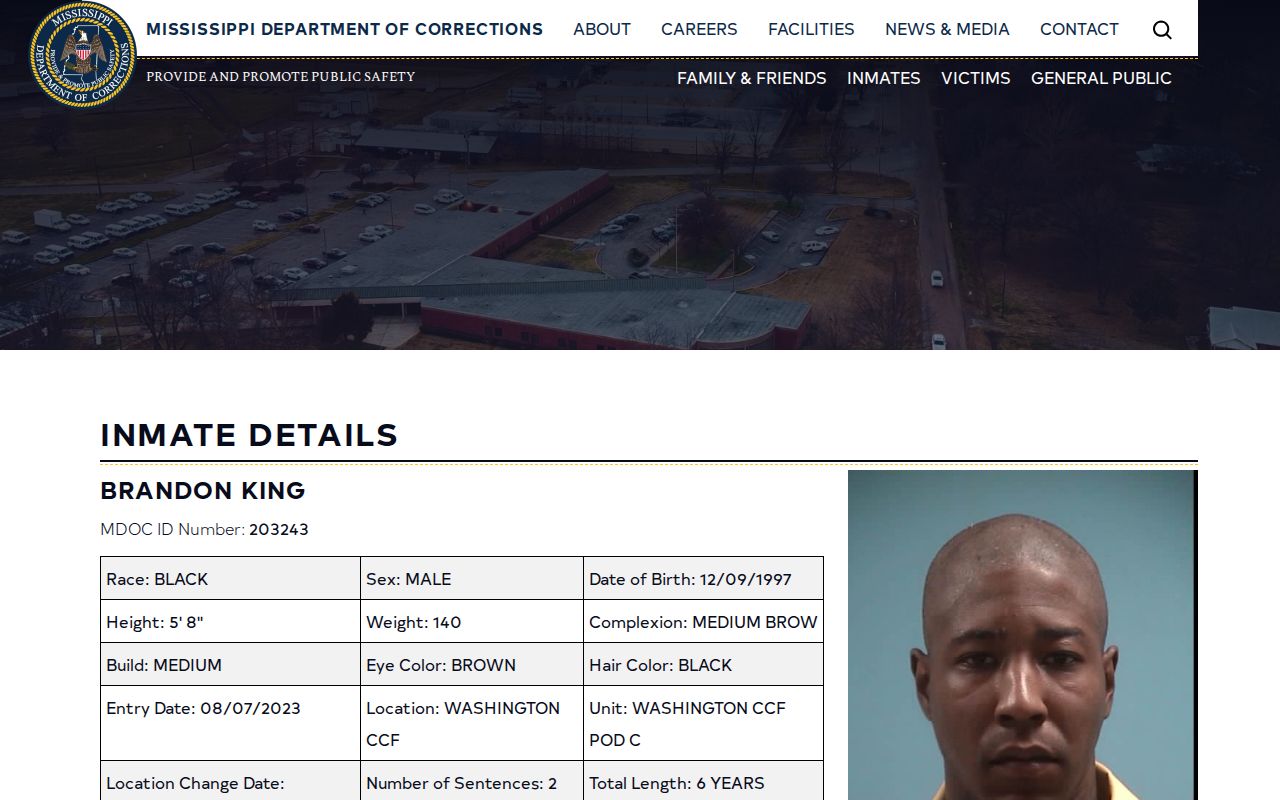
The screen demonstrates why the label, current location, sentence data, and record date should be saved together instead of copying one date alone.
Note: No search match is conclusive release proof; spelling, intake lag, system scope, and record changes can all hide a valid custody record.
Scott County MDOC Release Computation
MDOC’s handbook says the department computes prison terms and establishes parole, earned-release-supervision, tentative release or discharge, and maximum release dates. It starts from the sentence and qualifying dates, then applies the legal rules that fit the person’s offense and sentence. Eligible presentence or pretrial county-jail credit is deducted from the earliest sentence date to establish the sentence begin date. The credit must match the cause number and fall within the offense and sentence-date range. County time served after MDOC sentencing is not displayed as a separate jail-credit field.
Sentence structure matters. Concurrent terms run at the same time, while consecutive terms run one after another. An amended sentencing order may change a term. Detainers can affect release processing or move the person to another custodian. Forfeited earned time can move a tentative date later. Parole or ERS eligibility adds another date, but eligibility is not a guarantee that release will occur then.
The official handbook directs an incarcerated person to consult the case manager and timesheet for exact computation. It also states that release processing can involve travel and residence verification and a discharge certificate. That work may take 30 to 45 days. The period describes MDOC preparation, not a Scott County jail door-time rule and not a promise about the final day.
| Input or event | Possible effect on release date | Best source |
|---|---|---|
| Concurrent or consecutive terms | Changes how multiple sentences combine | Judgment and MDOC timesheet |
| Presentence jail credit | May move the sentence begin date | Court order and MDOC computation |
| Earned-time award or forfeiture | May move a tentative date earlier or later | MDOC timesheet |
| Detainer or agency hold | May cause transfer rather than community release | Custodian and receiving agency |
| Amended court order | May change term, credit, or authority | Filed court order |
| Parole or ERS action | May place the person under conditional supervision | Board and MDOC records |
Scott County Earned Release Time
Mississippi Code §47-5-138(5) provides that an eligible inmate serving a sentence imposed after June 30, 1995 may receive 4.5 days of earned time for each 30 days served for good conduct and performance. The credit is capped at 15 percent of the sentence. This is the source of the common “up to 15 percent credit” or “about 85 percent” shorthand.
The shorthand is not a release calculator. Eligibility exclusions, the offense, sentence date, conduct, forfeiture, other lawful credits, detainers, sentence structure, court orders, and Parole Board decisions still matter. Habitual-offender provisions and specified violent, sexual, and life sentences may carry exclusions or special rules. A person should use the current statute and MDOC computation, not subtract 15 percent from the sentence at home.
Section 47-5-138(6) treats early release under that provision as earned-release supervision through sentence expiration. The person remains an inmate under MDOC jurisdiction and is supervised in a manner similar to parole. If ERS is revoked, the statute provides for service of the remainder, and time spent in the community does not reduce that remainder. That is why an ERS date should not be called full discharge.
Note: The MDOC earned-time cap applies to eligible state sentences; no source supports applying it automatically to a Scott County jail term.
Scott County Tentative Date Quirks
MDOC’s vocabulary carries a built-in warning. The public profile says “Tentative Release Date,” while the handbook distinguishes parole dates, ERS dates, tentative discharge dates, and maximum dates. These are related but not interchangeable. A single percentage cannot reproduce the official timesheet because it cannot see every credited day, forfeiture, sentence relationship, amended order, eligibility rule, or active hold.
Read the current location with the date. A person still assigned to an MDOC facility has not been released merely because a future date appears. If a result later shows parole, check the separate Parolees Search and Board authority. If the result shows discharge or release, request the actual date and type when precision matters. This Scott County-specific path also applies to state prisoners housed locally in a Joint State/County work program, because their lasting sentence record remains with MDOC.
Scott County Jail Release Dates
A county sentence requires a separate calculation. The court’s term, credited time, and lawful order form the base. The sheriff applies the lawful county computation and checks active holds. No public Scott County good-time policy, weekend adjustment, or online calculator was verified. Do not transfer MDOC’s 15-percent earned-time cap to the local jail without legal authority for that sentence.
Ask detention for the release computation and the court for the sentencing order. If the case is pretrial, ask about the bond or release order and any other hold. A posted bond does not itself prove physical release. Identification work, unresolved bookings, warrants, detainers, and transfer arrangements may keep custody active after legal release authority appears. Once the jail confirms release, request the exact timestamp and disposition.
Disposition is crucial. “Released to MDOC,” “released to ICE,” or “transfer to another county” describes a change of custodian, not entry into the community. A Scott County release record should be paired with the receiving record. If the jail reports transfer to MDOC, allow for intake lag and then search the MDOC number or name. If the record identifies another jail or agency, that custodian holds the next event.
Confirm Scott County Actual Release
Near the projected day, the current custodian is the best source. For MDOC, the case manager and timesheet explain current computation, and a discharge certificate records the completed event. For Scott County detention, the booking-release ledger gives the physical timestamp and release disposition. The court explains legal authority, while the custody record explains movement.
Mississippi SAVIN/VINE can add notice. A registrant may receive release, transfer, return-to-custody, escape, or abscond-supervision events from participating agency systems. A transfer notice is not community release. The separate VINELink Release Check provides the person-search and notification path. Confirm every alert with the feeding jail or MDOC because data can lag and an event may not state the full legal reason.
For a full state history, use the MDOC GovQA portal and request the inmate summary, entry and discharge dates, release type, tentative-date history, sentence computation or timesheet, and supervision status. MDOC does not accept formal public-record requests by telephone. A focused written request gives a much stronger result than a screenshot of a future estimate.