
Scott County Release Record Basics
A release is a custody event tied to one booking or sentence. It does not always mean that a person walked out of the Scott County Jail and returned to the community. Bond, time served, a court order, and completion of a local jail term can end county custody. A transfer to the Mississippi Department of Corrections, another county, the U.S. Marshals Service, or immigration custody also ends the Scott booking while custody continues elsewhere. Death and escape are terminal roster events, but neither is a community release. The exact disposition in the Scott County Sheriff’s booking record is therefore more useful than a name simply vanishing from a list.
Scott County uses both “Scott County Jail” and “Scott County Detention Center” for the adult facility. The sheriff’s record is the first source for a person who left that jail. MDOC holds the durable record for a state sentence or a Joint State/County work-program prisoner. A court file explains the legal order, while VINE reports a custody event supplied by a participating agency. BOP covers federal custody, and ICE covers immigration detention. Each source answers a different question.
- Discharge
- The formal end of the custody or sentence status identified by the issuing agency.
- Time served
- A release based on completion of the custodial time ordered or credited by the court.
- Transfer
- Movement to another custodian, not release to the community.
- Detainer
- A hold or request from another agency that can prevent a local community release.
Scott County Inmate Release Types
The release type tells a reader what happened after the local booking ended. Read it with any hold, receiving-agency, court, or supervision field. A bond order authorizes release while the case continues, but processing or another hold can delay the physical exit. A dismissal resolves a charge or case and may support release, yet it does not erase an unrelated warrant or sentence. Parole and probation both involve the community, but parole follows a prison decision and probation comes from a court sentence.
| Record term | Meaning and next source |
|---|---|
| Bonded out | County custody ended while the case continues. Confirm the exit time with the sheriff and the bond order with the court. |
| Time served | The stated custodial term or credited time ended. Match the jail entry to the sentencing order. |
| Parole or ERS | The person left prison under state supervision. Check MDOC, its Parolees Search, and the Parole Board where needed. |
| Probation | A court imposed community supervision, which may occur without an MDOC prison release. |
| Transfer | Custody moved to MDOC, another jail, USMS, or ICE. Contact the receiving agency. |
| Dismissed | The named charge ended, but another case or hold may still control physical custody. |
Question: Does posting bond prove release? No. It proves that a bond step occurred. The jail’s release timestamp and disposition show whether physical county custody actually ended.
Scott County Release Record Fields
A useful request asks for the existing jail-docket, booking, and release fields tied to a defined booking episode. One person may have several bookings, and a single case may include release, revocation, return, and final discharge. Use at least two identity points, preferably full name and date of birth, and add the booking or case number when known. Never rely on a photograph or common name alone.
| Field | What it shows |
|---|---|
| Booking number | The identifier that ties the admission, charge, photo, and release to one episode. |
| Admission date and time | When the Scott County booking began. |
| Release date and time | The recorded end of that custodian’s physical hold. |
| Release disposition | Bond, time served, court order, transfer, or another coded reason. |
| Charges and bond | The case basis and bond status connected to the booking. |
| Arresting or releasing agency | Which office created or ended the custody event. |
| Hold or destination | Whether another agency received the person or maintained custody. |
| Booking photograph | The image linked to the arrest episode, subject to lawful exemptions. |
No official Scott County source reviewed states how long a released booking remains online, how often an online entry updates, or how long the underlying jail ledger is retained. Ask the sheriff to identify the record series and explain any code. Online display time is not the same as lawful retention.
Request Scott County Release Records
The Scott County Sheriff’s Office is the direct custodian to approach for an adult county jail booking and release. Its detention address is 531 Airport Road, Forest, MS 39074, and the main telephone is 601-469-1511. Call first to learn the sheriff’s accepted written method. Scott County publishes a Board of Supervisors request form, but its policy notes that independently elected officers may use their own procedure. Sending a Board request alone should not be assumed to reach sheriff records.
- Identify the person by full legal name, aliases, date of birth, and a narrow booking date range.
- Ask for the booking sheet or jail-docket entry, admit and release times, disposition, charges, bond, and releasable receiving-agency or hold fields.
- Request an electronic copy, the definition of any code, and all nonexempt portions after lawful redaction.
- Ask for a written fee estimate before costs are incurred and request the specific exemption for any denied field.
- Compare the sheriff event with the Justice or Circuit Court order that explains the legal reason.
The county Board policy lists $0.50 per page and $20 per hour for research or processing, plus actual special-production, delivery, attorney, or redaction costs. Confirm whether those rates apply to the elected sheriff before stating a jail-record cost. The policy describes production within seven business days or a written explanation, ordinarily no later than fourteen business days unless another lawful condition applies. These time limits come from the published policy and state law, not a promise that each request will take the full period.
Scott Release Records Under State Law
The Mississippi Public Records Act, Mississippi Code §25-61-1 and following, broadly includes photographs and other material prepared or held for public business. Section 25-61-5 governs procedures and written denials. Section 25-61-7 limits charges to actual search, review, duplication, and mailing costs. Section 25-61-10 addresses an available requested format, and §25-61-12 distinguishes exempt investigative reports from public incident information while protecting specified personal data. A focused request for release fields and a matched booking photo is stronger than a demand for every investigative file.
Juvenile records follow a separate rule. Mississippi Code §43-21-261 protects Youth Court material, so the adult Scott County release workflow cannot be used to publish a youth’s identity or status. Expunction under §99-19-71 may change public access to an eligible adult record after a court grants relief. Eligibility is offense-specific, and no numeric waiting period is stated here because current legislation and codification require direct verification. No official source reviewed established a Mississippi rule that forces a private mugshot publisher to remove an image for free.
Scott Release Orders in Court
Scott County’s court structure adds a local verification step. Justice Court handles misdemeanors, county matters, and the first stage of every felony. The county says judges hold jail sessions three times each week to provide initial appearances within three days. That court may hold the first bond or release order. Felony prosecution and sentencing then proceed through Circuit Court District 8, where the Circuit Clerk keeps indictments, motions, judgments, and other criminal filings.
The Mississippi Electronic Courts access page explains the state electronic docket system. Scott Circuit’s MEC service began on August 26, 2024, so older or differently filed matters may still require clerk contact. A docket entry can explain bond, dismissal, sentence, probation, revocation, or an order of release. It still does not prove the precise time the jail completed processing.
The court record supplies legal authority; the sheriff or receiving agency supplies the physical custody event. Neither source should be forced to answer the other source’s part of the timeline.
Find Scott County Released Inmates
Start with the last known custodian, not the charge alone. A Scott County arrest can lead to the county jail, another county, MDOC, federal custody, or immigration custody. The source that last held the person is best placed to confirm the physical movement. A current roster is useful only while a person remains confined. Once the booking ends, the historic release record, court disposition, or receiving-agency record becomes the stronger trail.
- For a recent county booking, call Scott County detention and request the exact release status, time, disposition, and any transfer destination.
- Request the historic booking and release entry when written proof is needed.
- Use the court case to identify bond, dismissal, sentence, revocation, or transfer authority.
- Search MDOC only when a state sentence, state transfer, parole, or Joint State/County placement applies.
- Use Mississippi SAVIN/VINE as a notification and corroboration layer, then confirm with its source agency.
- Use BOP for federal custody and ICE ODLS for an immigration handoff.
Question: Is no search result proof of release? No. A miss can reflect spelling, lag, a different custodian, limited online history, confidentiality, or a transfer. Confirm the event at its source.
Scott Release Roster Redirect Explained
The Scott County Sheriff website displays an “Inmate Roster” link, but the reviewed link sends users to Mississippi’s statewide MDOC search. It does not expose a Scott County booking list, a county release timestamp, or an official 24-hour or 72-hour release feed. This is a key local limitation. An MDOC result can verify state custody or history, but it cannot prove that an ordinary Scott County jail booking ended in bond release.
The official sheriff screen shows the navigation path that creates this distinction.

For a county release, use detention contact and a written booking-release request. A one-day or three-day inquiry should name exact calendar dates and local start and end times without claiming that Scott publishes a feed.
Note: The sheriff’s general alert page was unfinished when reviewed and is not a substitute for Mississippi SAVIN/VINE registration.
MDOC Search for Scott Releases
The Mississippi Department of Corrections homepage provides separate Inmate Search and Parolees Search tools. Each accepts first name, last name, or MDOC ID. The MDOC number is the best match when known. Open the individual record and read the exact status, location, sentence, conviction, and date labels. A future “Tentative Release Date” is an estimate. It is not proof that release happened, and a blank date does not mean an event is near.
| Search field | Use | Limit |
|---|---|---|
| First name | Starts a name search | May return namesakes or spelling variants |
| Last name | Finds matching MDOC records | Needs another identity point |
| MDOC ID | Targets a state identifier | Does not replace review of the live status |
| Parolees Search | Checks a parole classification | No result does not exclude probation, ERS, or discharge |
The official MDOC screen presents both state searches.
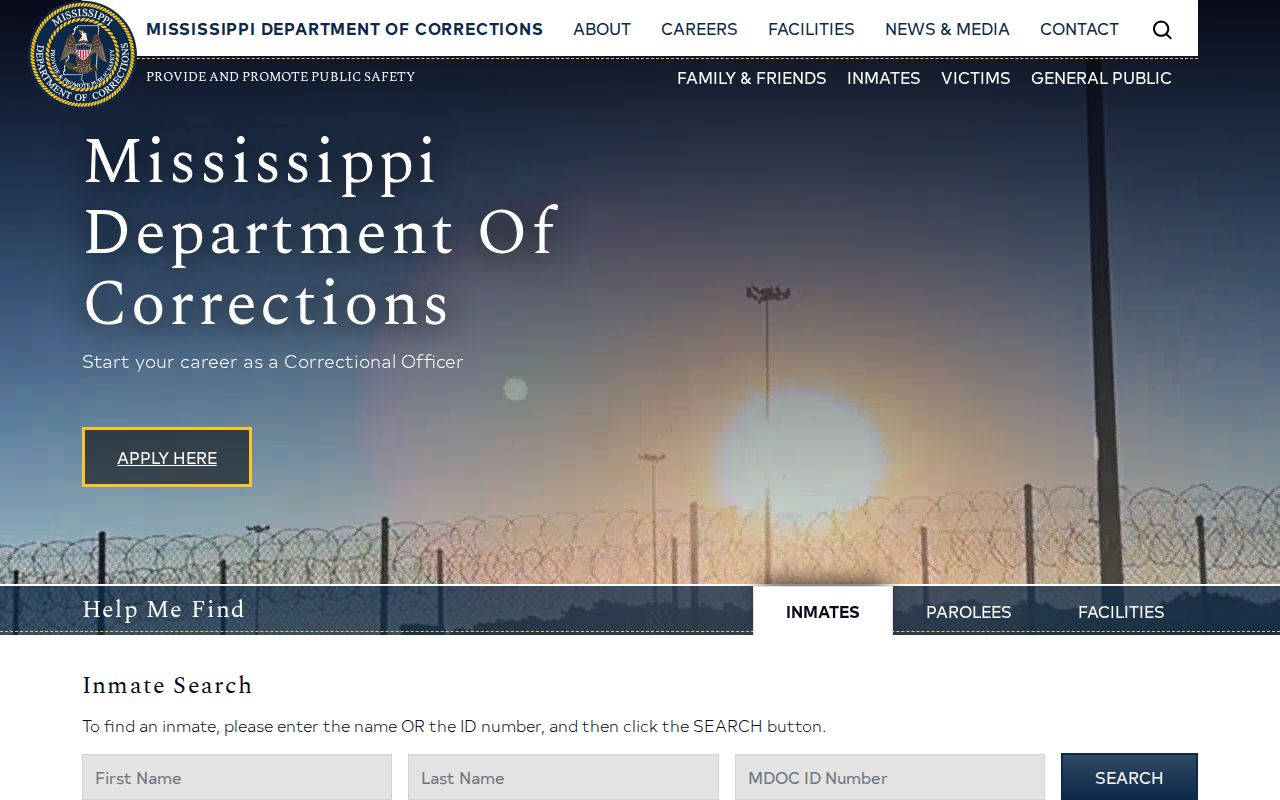
This state route belongs to a state prisoner or parolee. It is not Scott County’s jail archive. For missing history, MDOC directs written public-record requests to GovQA and does not accept telephone public-record requests.
Scott Release Supervision and Notices
The Mississippi State Parole Board makes parole decisions. MDOC Community Corrections carries out parole, probation, earned-release supervision, and other state community supervision. Scott County has an MDOC Probation and Parole Office at 531 Airport Road in Forest, with a separate phone from the jail: 601-469-3376. A parolee has left prison conditionally but has not fully completed the sentence. Probation comes from a court order and may not follow prison at all. Earned-release supervision, often called ERS, keeps the person under MDOC authority through sentence expiration.
Mississippi SAVIN/VINE reports events such as release, transfer, return to custody, escape, and return from abscond supervision. Search the correct person, compare the agency and identifiers, and read the exact event. A transfer notice signals a new custodian, not community release. The state’s Registration Link can continue notification when someone moves from county custody into MDOC or another participating system.
Scott Release Custody Boundaries
Use the BOP Inmate Locator for a federal prisoner. It searches by federal identifier or biographical fields and may show a release date with “RELEASED” or “Not in BOP Custody.” That wording means BOP no longer holds the person. State, local, ICE custody, or federal supervised release can still follow. A future BOP date is projected and can change.
When a Scott record says the person was released to ICE, read it as a transfer. The ICE Online Detainee Locator accepts an A-number with country of birth or exact biographical details. It is a current locator, not a release archive, so a miss is not proof of freedom. USMS can also move federal pretrial detainees among contract facilities. The federal court order, holding facility, and receiving record must be aligned.
- Scott Sheriff
- Confirms a county booking, release time, disposition, or transfer, but not later state, federal, or immigration status.
- MDOC
- Shows state custody, sentence fields, parolee status, and state discharge history, but not an ordinary county bond-out.
- VINE and court
- VINE reports a supplied event. Court records show legal authority. Neither alone supplies a certified physical release timeline.
- BOP and ICE
- BOP covers federal custody, while ICE covers current immigration detention. Neither substitutes for Scott County records.
Scott Jail Release Capacity Context
The sheriff administration history says a newer detention center expanded capacity from 50 to 200. The current jail page separately describes space for up to 323 detainees and an 86-person minimum-security work-camp office. These are official statements from different contexts. They should not be combined into a new capacity or treated as current population data.
The work-program detail also matters for release searches. A Joint State/County work-program prisoner may be physically housed in Scott County but remain an MDOC prisoner. That person’s lasting sentence and release path runs through MDOC in addition to any local physical-custody confirmation. Video court at the jail can handle first appearances, arraignments, and bond hearings, but the court order and jail processing record still answer different parts of the release.
The official facility page displays the locally sourced jail details.
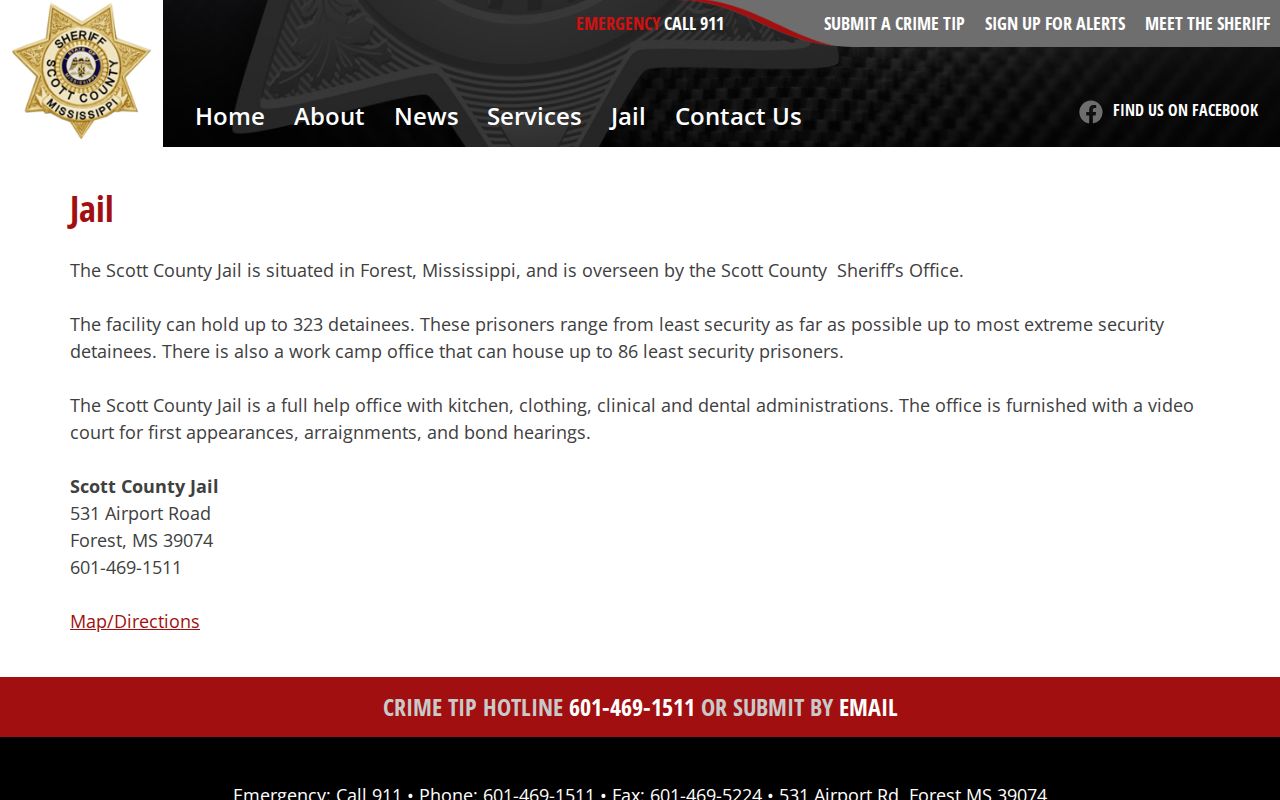
Those facts support the adult jail route without turning the stated capacity into a release count.
Scott County Release Facilities
The Scott County Jail / Scott County Detention Center is the primary adult local facility. A direct community release appears in the sheriff’s booking-release record. A transfer to MDOC, another jail, USMS, or ICE must be followed to the receiving agency. The local work-camp component does not create a separate public lookup system.
The Scott County Juvenile Detention Center follows Youth Court and juvenile-services channels. No independent public address, adult-style release feed, or photo system was verified. Parents, guardians, counsel, and other authorized people should contact Youth Court or the sheriff. A missing adult search result is expected and says nothing about a youth’s release.
Forest Police may make an arrest, but its official page does not establish a separate long-term jail. Confirm the actual booking facility instead of assuming the arresting department held the person through release. No state prison, BOP institution, or published ICE detention facility was found within Scott County.
Public Record Search
Sponsored Results